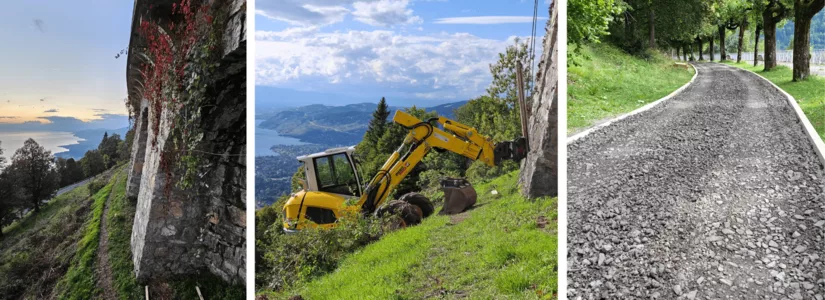
Biocementation wall stabilization provides a sustainable alternative to traditional grouting methods for historic structures and heritage sites. This case study examines how Medusoil applied biocementation technology to stabilize the historic wall at Caux Palace, Switzerland, reducing carbon emissions by 60% compared to conventional cement injection while improving soil strength and preventing differential settlement.
Key outcomes:
- Non-invasive soil improvement with minimal site disruption
- 60% reduction in CO₂ emissions vs. traditional methods
- Zero excavation or heavy machinery required
- Validated performance through 5D monitoring framework
What Is Biocementation for Wall Stabilization?
Biocementation is a biological soil improvement technique that strengthens ground conditions through microbially induced calcite precipitation (MICP). Unlike conventional cement grouting, biocementation uses bio-sourced, low-viscosity fluids that flow naturally through soil, targeting the most permeable zones where settlement typically originates.
Biocementation vs. Traditional Stabilization Methods
| Method | CO₂ Impact | Site Disruption | Heritage Compatibility |
|---|---|---|---|
| Cement grouting | High | Significant | Limited |
| Mechanical compaction | Medium | Very high | Poor |
| Biocementation | Low (-60%) | Minimal | Excellent |
Traditional wall stabilization methods often require:
- Heavy excavation and spoil removal
- High-pressure cement injection
- Significant logistical footprint
- Extended site access restrictions
Biocementation eliminates these constraints while delivering comparable or superior soil improvement results.
Learn more:
Caux Palace Wall Stabilization Project: Complete Overview
The Caux Palace wall stabilization project demonstrated how biocementation technology addresses complex geotechnical challenges on sensitive heritage sites. The 19th-century structure required soil improvement to prevent progressive settlement without compromising its historical integrity.
Project Challenges
- Differential settlement affecting wall stability
- Limited access for conventional equipment
- Heritage preservation requirements
- Heterogeneous soil conditions with variable moisture content
- Need for verifiable, long-term performance data
Solution Approach
Medusoil designed a three-phase program combining non-destructive investigation, targeted biocementation treatment, and comprehensive monitoring to deliver measurable soil improvement with minimal environmental impact.
Phase 1: Non-Destructive Subsurface Mapping and Site Investigation
Before applying biocementation treatment, understanding subsurface conditions is critical for wall stabilization success. Medusoil used advanced geophysical techniques to map soil properties without excavation:
Electrical Resistivity Tomography (ERT)
ERT revealed moisture distribution patterns and material contrasts that control settlement behavior. This data identified preferential flow paths where biocementation fluids would naturally concentrate.
Ground-Penetrating Radar (GPR)
GPR detected near-surface heterogeneities and structural features affecting wall support. Combined with ERT, this provided a complete 3D model of subsurface conditions.
Why this matters for biocementation: Non-destructive mapping reduces uncertainty before treatment, enabling engineers to design targeted interventions that follow natural soil permeability rather than forcing uniform coverage.
Related applications:
Phase 2: Low-Pressure Biocementation for Soil Improvement
Medusoil’s biocementation system uses low-pressure, low-viscosity injection to improve soil strength selectively. The treatment follows this principle: strengthen where settlement begins.
How Biocementation Works in Wall Stabilization
- Bio-sourced fluid injection: Low-viscosity solutions flow through natural soil pathways
- Microbial calcite precipitation: Biological processes create calcium carbonate bonds between soil particles
- Selective reinforcement: Treatment concentrates in high-permeability zones where settlement risk is greatest
- Gradual strength development: Soil properties improve over days to weeks as mineralization progresses
Environmental Benefits of Biocementation
- 60-80% lower CO₂ emissions compared to Portland cement grouting
- No heavy machinery or excavation required
- Minimal waste generation
- Circular production pathway using bio-sourced materials
- Compatible with heritage conservation standards
Technical resources:
Phase 3: 5D Monitoring for Performance Validation
Wall stabilization projects require verifiable performance data. Medusoil implemented a “5D monitoring” framework to track treatment effectiveness across multiple dimensions:
5D Monitoring Components
1. Spatial Monitoring (2D/3D)
- Follow-up ERT and GPR surveys to map treated zones
- Identify changes in soil stiffness and moisture retention
2. Temporal Tracking
- Continuous observation during and after treatment
- Document strength development timeline
3. Biogeochemical Monitoring
- Track mineralization progress through chemical indicators
- Verify treatment completion and uniformity
4. Environmental Monitoring
- Measure temperature, moisture, and groundwater influence
- Understand factors affecting biocementation performance
5. Structural Response Tracking
- Vertical displacement measurements at wall reference points
- Validate that settlement has stopped or reduced
Why multi-dimensional monitoring matters: Single-indicator assessments miss important interactions. 5D monitoring provides complete evidence for stakeholders, regulators, and structural engineers.
Case study comparison:
Why Biocementation Is the Future of Eco-Friendly Wall Stabilization
Biocementation technology addresses three critical trends in geotechnical engineering:
- Decarbonization requirements: Construction sectors face increasing pressure to reduce embodied carbon. Biocementation delivers immediate CO₂ reductions without compromising performance.
- Heritage preservation: Historic structures require minimally invasive solutions. Biocementation works with existing conditions rather than forcing major interventions.
- Evidence-based validation: Modern projects demand measurable outcomes. Advanced monitoring proves biocementation effectiveness to all stakeholders.
Scientific background:
Best Practices for Biocementation Wall Stabilization Projects
Based on the Caux Palace case study, these principles optimize biocementation outcomes:
1. Invest in Early Subsurface Investigation
Non-destructive mapping reduces risk and improves treatment design. Understanding permeability distribution before injection ensures biocementation targets the right zones.
2. Design Around Natural Flow Paths
Biocementation works best when engineered to follow subsurface hydrology. Low-viscosity fluids naturally concentrate where treatment is needed most.
3. Implement Comprehensive Monitoring From Day One
Multi-dimensional monitoring validates performance, supports regulatory approval, and provides documentation for future maintenance planning.
4. Consider Site-Specific Constraints Early
Heritage requirements, access limitations, and environmental sensitivity should drive design decisions, not constrain them afterward.
A: Injection typically requires 1-3 weeks depending on site size. Strength development continues for 4-8 weeks as mineralization completes.
A: Yes. Calcium carbonate bonds are stable and durable under normal groundwater conditions. Performance monitoring confirms long-term effectiveness.
A: Biocementation is most effective in permeable soils (sands, gravels, silty sands). Very fine clays may require alternative approaches.
A: Project costs are comparable, but biocementation often reduces total expenses by eliminating excavation, disposal, and extended site closure.
A: Yes. Biocementation has been successfully applied to slope stabilization projects including active movement scenarios.
Contact Medusoil for Wall Stabilization Engineering Support
If your project involves wall movement, differential settlement, or heritage structure stabilization, Medusoil’s engineering team can assess biocementation feasibility and develop a site-specific investigation and treatment plan.
Share your project details:
- Site location and access constraints
- Structure type and heritage status
- Settlement observations and monitoring data
- Performance requirements and timeline